Computer vision is one of the most over-explained and least understood technologies in warehousing. This is a no-jargon explanation of what it actually does on a dock, how it fails, and what a warehouse team should expect from it.
What it really does
Computer vision converts pixels into labelled observations. On a dock, that means answering a small number of specific questions from a video frame: is there a trailer in this region, is a truck cab attached to it, is anything moving in the doorway. Each answer comes with a confidence score, and the software turns a stream of those answers into stable states.
Detection versus state
A single frame detection is noisy. A person walking past can briefly change what the model sees. Useful systems never act on one frame. They smooth detections over time so that a dock state only changes when the evidence has been consistent for a defined window. That smoothing is the difference between a system your supervisors trust and one they mute.
Zones do most of the work
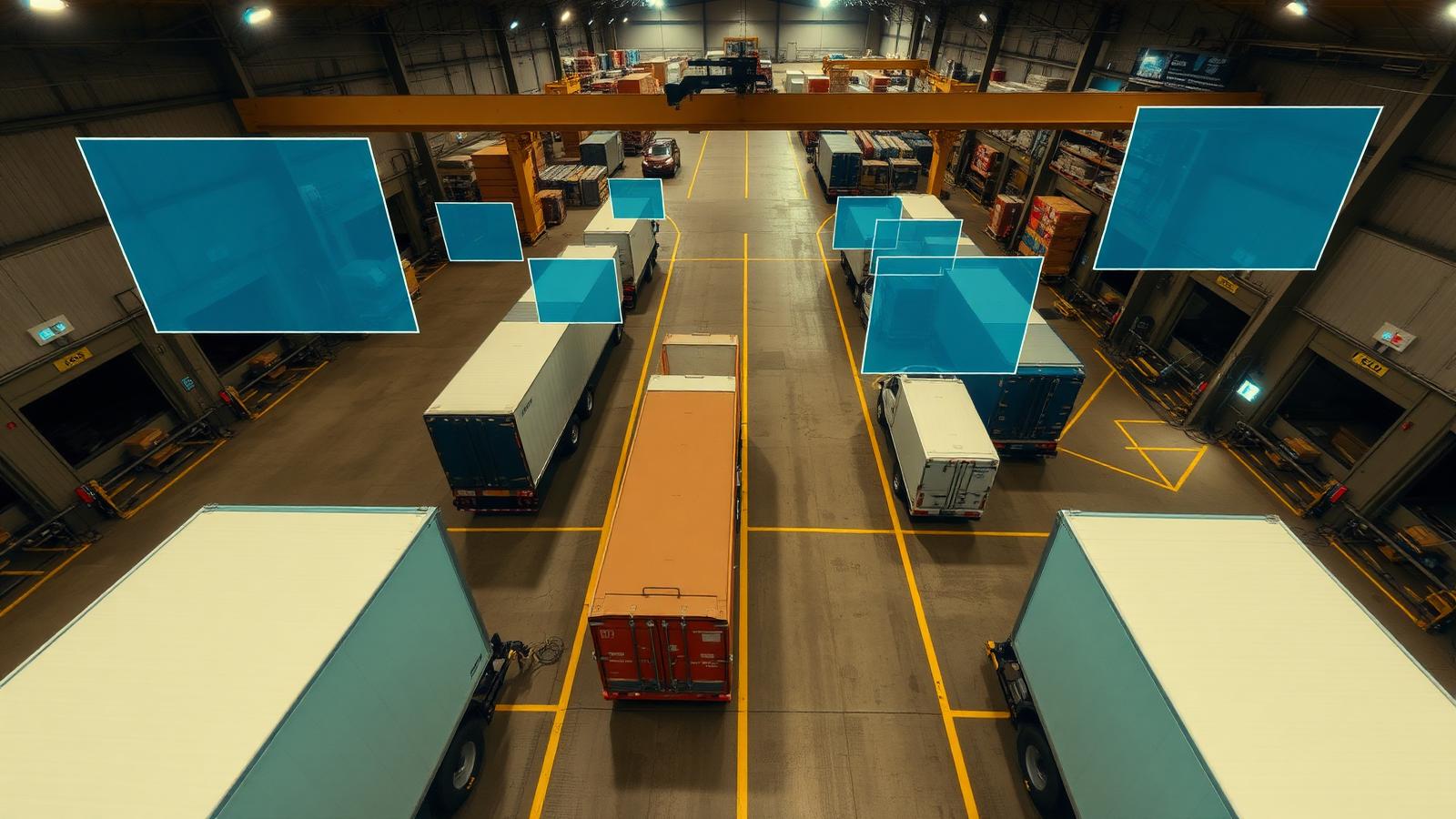
Accuracy on a dock comes less from the model and more from the configuration. Telling the system which region of the frame is the trailer area and which is the truck area removes almost all ambiguity. Two sites with identical models and different zone configuration will get very different results.
What it does not do
- It does not understand context. It knows a trailer is present. It does not know that trailer is late, cross-docked, or high priority unless another system tells it.
- It does not read intent. It cannot tell whether a stationary lift truck means a break, a jam, or a shift change.
- It does not see what the camera cannot. Occlusion, glare and bad angles are physical limits, not tuning problems.
- It does not replace supervision. It removes the need to watch, not the need to decide.
How it fails, and what good failure looks like
| Failure mode | Cause | Good system behaviour |
|---|---|---|
| Flicker between states | Borderline confidence at zone edges | Temporal smoothing and a hold period |
| Missed trailer at night | Poor IR coverage | Flag low-confidence periods rather than guessing |
| Stream drop | Network or NVR issue | Explicit offline state, frozen last-known timers |
| Sun glare at shift change | Camera orientation | Confidence drop surfaced, not silently absorbed |
The last column matters more than any accuracy percentage. A system that admits uncertainty is far more useful than one that quietly reports a confident wrong answer.
Ask to see an annotated frame. If a vendor can show you the live frame with the detected trailer and the configured zone drawn on it, the system is inspectable. If they cannot, you are being asked to trust a number with no way to verify it.
What a warehouse team should expect
- Configuration in a browser, per door, in minutes rather than a site visit.
- Visible reasoning through annotated frames.
- Explicit health reporting for every camera.
- Stable states, not raw detections, feeding your dashboards and alerts.
Key takeaways
- Vision answers narrow questions well and contextual ones not at all.
- Zone configuration drives accuracy more than the model does.
- Honest failure handling beats headline accuracy claims every time.